Clear guidance for modern India.
Blogexamples is an independent India-first digital publication built for readers who want technology and modern life explained without noise. The brand may be found through searches for blogexample or the domain blogexample.com; both lead to the same editorial promise.
Why Blogexamples exists
The internet offers more information than most people can reasonably evaluate. Launch coverage, creator claims and short videos often remove the context that explains who advice is for, how much it costs over time and what could go wrong.
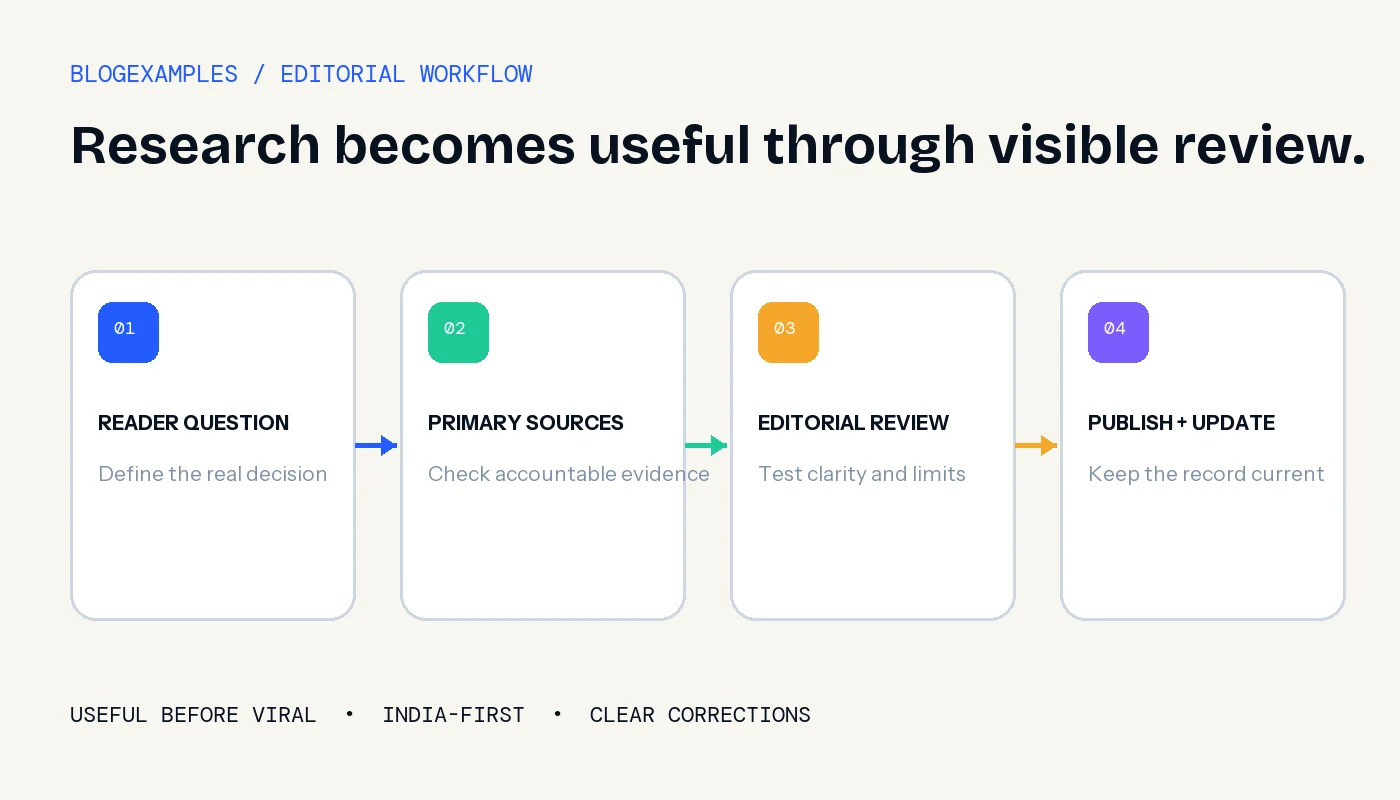
Blogexamples starts with a reader's real decision. We identify the outcome, relevant Indian conditions, credible evidence, limitations and the smallest useful next step before deciding how long an article should be.
That purpose shapes what Blogexamples does not publish as well. A page without a clear audience, verifiable value or responsible next step is revised, combined with stronger coverage or left unpublished rather than used to inflate the archive.
An India-first point of view
India is not a single use case. Connectivity, language, climate, accessibility, service networks, payment habits and household budgets differ across states, cities and communities.
Our reporting names the conditions that may change a recommendation. We use rupee costs where useful, check locally available services and avoid presenting a metro-only experience as a universal national answer.
Writers state the local assumption behind a recommendation and point readers to the detail that needs personal verification. This creates room for regional difference without turning every article into an unhelpful list of disclaimers.
Eight connected editorial desks
Technology, health, business, education, entertainment, gaming, lifestyle and travel are separate desks, but everyday questions frequently cross their boundaries.
Editors link those connections deliberately. A device guide may lead to a privacy checklist, a course comparison may connect to responsible AI use and a travel guide may point to payment or digital-safety preparation.
The shared structure lets readers continue naturally from one question to the next. It also prevents eight categories from becoming isolated collections with no editorial relationship, which strengthens both navigation and topical understanding.
Useful before viral
Popularity can reveal what people are discussing, but it does not prove that a claim is accurate, safe or worth a reader's money.
We choose topics for durable reader value, not only search volume. A headline must describe the real article, and the body must supply evidence, trade-offs and actions that justify the reader's attention.
Editors look for the useful life of a topic, the evidence needed to support it and the decision a reader can make afterwards. Timeliness matters, but it does not replace accuracy, context or a headline that faithfully describes the page.
How a guide is built
A strong guide begins with one clear search intent and a defined audience. Research prioritises primary documentation, accountable institutions and credible specialist reporting.
Drafts are organised with descriptive headings, reviewed for unsupported certainty and checked for relevant internal links. Publishing and updated dates stay visible so readers can judge freshness.
Before publication, another review checks the search intent, structure, unsupported certainty, links, image text and mobile reading experience. The updated date changes only when the substance changes, so freshness remains meaningful.
Health, money and other sensitive decisions
Some topics need a higher standard because an error can affect wellbeing, finances, safety or legal obligations.
Blogexamples distinguishes general education from individual professional advice, makes uncertainty explicit and directs readers to qualified or emergency support when an article cannot responsibly answer the personal question.
Extra care includes stronger sourcing, explicit boundaries and a clear route to professional or emergency support. The article should help a reader ask better questions without pretending that general publishing can replace an individual assessment.
Commercial independence and disclosure
Readers should be able to tell when a recommendation is influenced by access, sponsorship, affiliate compensation or another material relationship.
Commercial terms do not purchase a positive conclusion. Relevant relationships are disclosed, factual claims remain reviewable and editorial staff retain control of selection, language and corrections.
Reviews and recommendations identify the factors that shaped the conclusion, including cost, access, limitations and any material relationship. A disclosure is useful only when it is close enough to the decision for a reader to notice.
Corrections and meaningful updates
Trust does not require pretending that a publication never makes a mistake. It requires a dependable way to examine concerns and repair significant errors.
We assess reported issues against the source record, correct material inaccuracies promptly and note meaningful changes when the previous wording could affect a reader's understanding or decision.
A correction request is matched to the exact claim and strongest available record. Significant changes receive an explanation, while routine spelling or formatting fixes do not create a misleading impression that the research was newly refreshed.
Accessibility, privacy and respect
A useful publication should be readable on small screens, work with keyboard navigation and avoid collecting information it does not need.
We use clear hierarchy, descriptive alternative text, visible focus states and restrained page weight. Contact details are handled only for the stated purpose and protected by the site's privacy practices.
Accessibility and privacy are treated as publishing requirements rather than optional enhancements. The team checks keyboard focus, readable contrast, meaningful alternative text, responsive layouts and whether a form asks only for information it needs.
How to use and challenge our work
Readers can begin with a category desk, follow contextual links inside an article or use the global search to locate a specific question.
Questions, correction requests and responsible criticism are welcome through the contact page. The editorial policy explains what information helps us investigate and respond efficiently.
Useful criticism is specific: the URL, exact wording, date and supporting source help an editor investigate. Readers can also ask how a conclusion was reached, suggest a missing perspective or flag an obstacle that made the page difficult to use.